Abstract
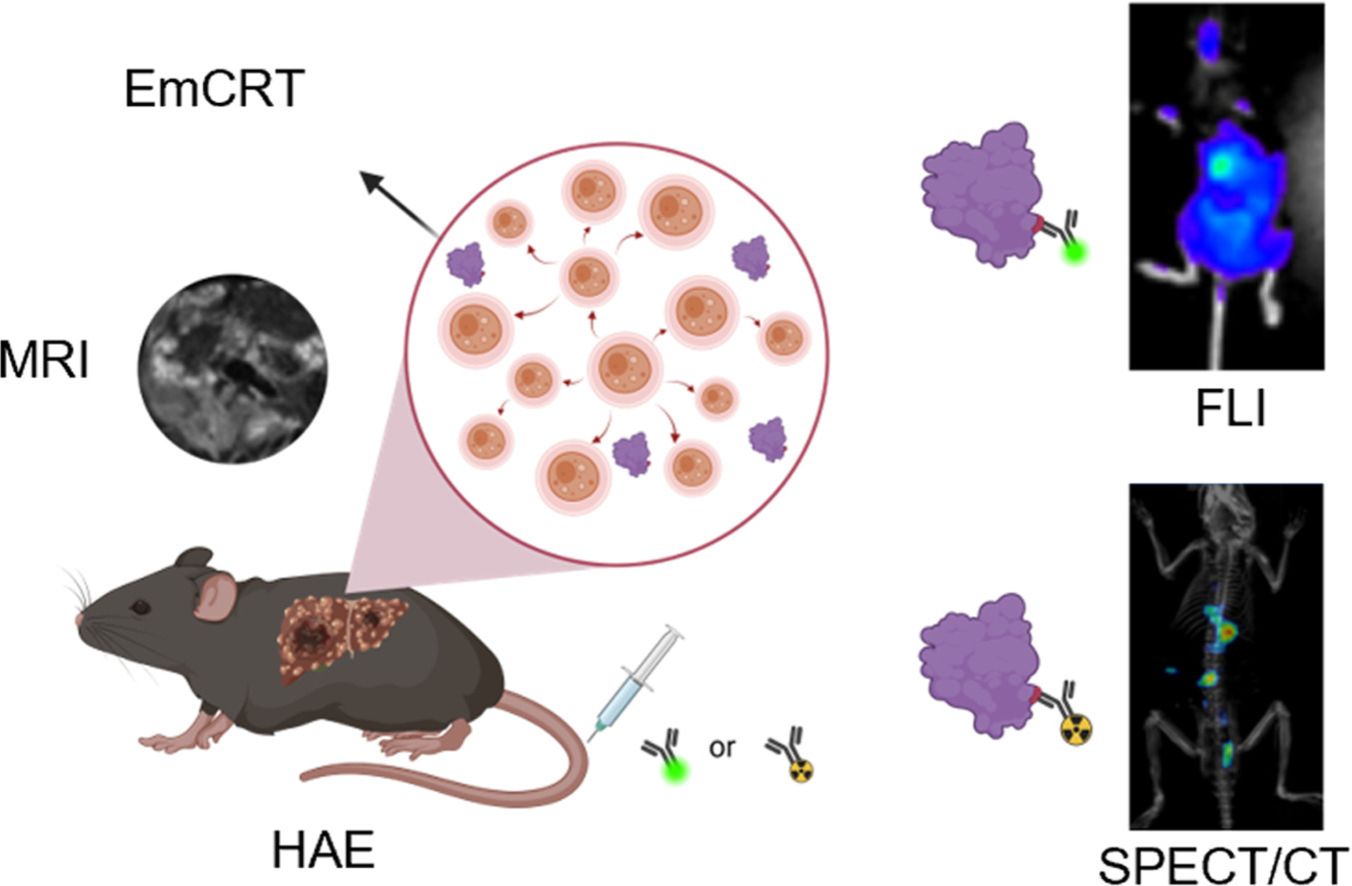
Alveolar echinococcosis, a lethal zoonotic infection caused by Echinococcus multilocularis (Em) larvae, urgently requires specific diagnostic methods to improve patient outcomes. This study developed and validated the first polyclonal antibody-based molecular imaging probes targeting Em calreticulin (EmCRT), a secreted and surface-exposed parasite antigen. Two high-affinity antibodies, pAb-EmCRT-1 and pAb-EmCRT-2, were generated and demonstrated binding to native EmCRT in infected liver tissue, vesicle fluid, and protoscoleces via immunofluorescence. For in vivo application, the antibodies were conjugated with the near-infrared fluorophore Cy7, confirming their lesion-targeting capability in mice with hepatic alveolar echinococcosis. To achieve clinical translation, the antibodies were successfully radiolabeled with iodine-131. Subsequent single-photon emission computed tomography/ computed tomography (SPECT/CT) imaging revealed specific and prolonged accumulation of 131I-pAb-EmCRT-1/2 at hepatic infection sites, in contrast to their rapid clearance in healthy controls. This study establishes EmCRT as a robust diagnostic target and provides a clinically translatable imaging strategy for precise and non-invasive detection of alveolar echinococcosis.
文章链接:https://doi.org/10.1016/j.cclet.2026.112888
文章导读:https://mp.weixin.qq.com/s/CtjoSerilaLL60cbyEELdQ