Abstract
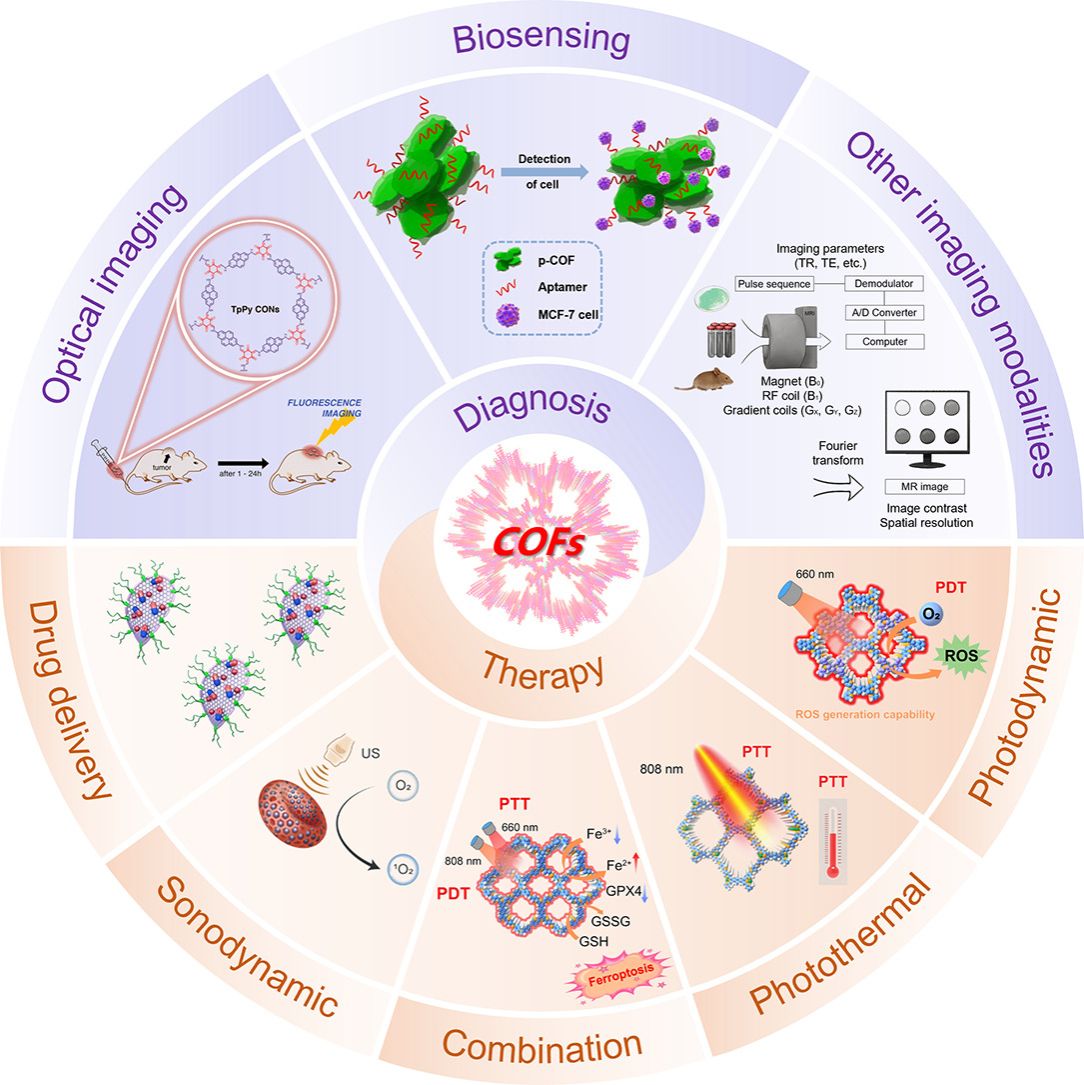
Currently, tumor diagnosis and treatment strategies based on traditional nanomaterials are hindered by challenges related to sensitivity, targeting, and stability. Covalent organic frameworks (COFs), with their intrinsic porosity, high specific surface area, tunable functionality, and ordered π-conjugated systems, have emerged as a promising solution. In recent years, the application of COFs in tumor diagnosis and therapy has evolved from proof-of-concept studies to advanced platforms that seamlessly integrate multimodal imaging with combination treatment strategies. In the realm of diagnostics, COFs offer effective encapsulation and controlled delivery of contrast agents, thereby significantly enhancing imaging performance. For instance, COFs improve imaging in modalities such as magnetic resonance imaging (MRI), optical imaging, and single-photon emission computed tomography/computed tomography (SPECT/CT). Additionally, COFs serve as highly efficient candidates for biosensor applications and biomarker detection. In therapeutic applications, COFs enable efficient drug loading and targeted delivery, showcasing promising potential in various treatment modalities, including radiotherapy, phototherapy, sonodynamic therapy (SDT), immunotherapy, catalytic therapy, and combination treatments. This review aims to synthesize the current progress in COF-based platforms for tumor diagnosis and therapy, highlighting innovative strategies to overcome existing challenges and providing a comprehensive framework for future research directions.
文章链接:https://doi.org/10.1016/j.cej.2025.165302