Abstract
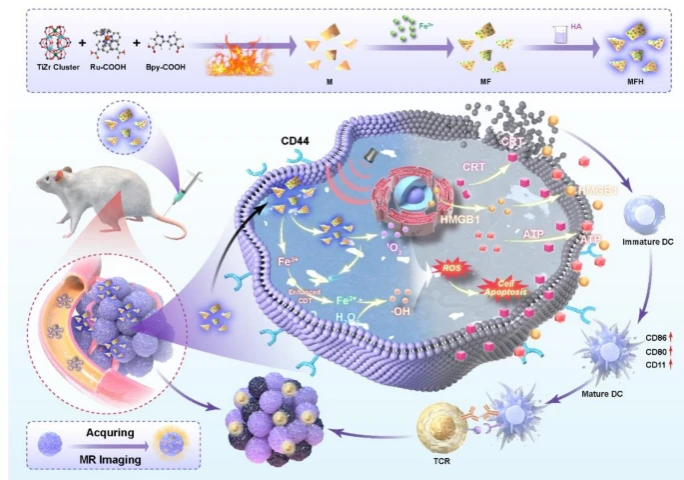
Sonodynamic therapy (SDT) exhibits clinical potential for deep-tissue tumor treatment due to its deep tissue penetration and spatiotemporal controllability. Its core mechanism relies on ultrasound-activated sonosensitizers to generate reactive oxygen species (ROS), thereby inducing tumor cell apoptosis. However, conventional sonosensitizers face limitations in ROS yield and tumor-targeting efficiency. In this study, we innovatively designed a multifunctional metal–organic nanosheet (TiZrRu-MON) by hydrothermal coordination of [Ru(bpy)₃]2⁺ photosensitizing units with TiZr-O clusters, while incorporating Fe3⁺ to construct a cascade catalytic system. Experimental results demonstrated that: (1) Fe3⁺ lattice doping significantly enhanced charge carrier mobility and ultrasound-triggered 1O₂ quantum yield via the formation charge transfer channels; (2) The acidic tumor microenvironment activated Fe3⁺-mediated Fenton reactions, establishing a positive feedback loop with SDT to synergistically amplify ROS generation; (3) Hyaluronic acid functionalization improved nanosheet internalization in HepG2 tumor cells through CD44 receptor-mediated endocytosis. Remarkably, ultrasound irradiation induced substantial oxidative stress and immunogenic cell death, promoting the release of damage-associated molecular patterns (DAMPs), which elevated the maturation rate of tumor-infiltrating dendritic cells (DCs) and significantly increased the proportion of CD8⁺ T cells. In a mouse subcutaneous tumor model, the system achieved effective tumor suppression with manageable systemic toxicity. This work proposes a metal–ligand coordination strategy to advance the development of high-performance sonosensitizers and immunomodulatory antitumor technologies.
文章链接:https://link.springer.com/article/10.1186/s12951-025-03599-1#citeas