Abstract
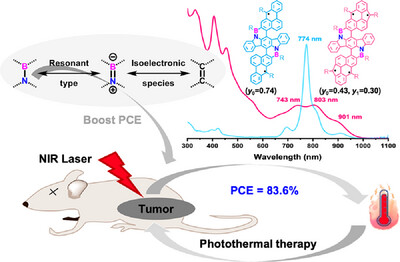
Traditional inorganic photothermal agents (PTAs) suffer from poor biodegradability, while undoped carbon-based materials exhibit low photothermal conversion efficiency (PCE). In contrast to the established organic PTAs with donor–acceptor architectures, herein, we developed a new class of atomically precise BN-doped polycyclic hydrocarbons (PHs) featuring stable diradicaloid (BN-Dira: y0 = 0.74) and tetraradicaloid (BN-Tetra: y0 = 0.43, y1 = 0.30) character for high-efficiency photothermal therapy (PTT). Our design is based on the synergistic integration of 1,2-BN units and radical engineering within an expanded π-conjugated skeleton. The complementary electron-donating (N) and electron-accepting (B) sites effectively modulate the intramolecular charge distribution, which promotes effective electron delocalization. The resulting compounds exhibit exceptional ambient stability, with the tetraradicaloid species demonstrating half-lives of over 1 year. In addition, the engineered compound BN-Dira exhibit high NIR absorption and PCE of 83.6%. In vitro, they induce rapid cancer cell apoptosis under NIR irradiation (808 nm). In vivo murine models confirm efficient tumor eradication with minimal side effects. This work establishes a new protocol for stable, radical-based PH PTAs, providing a solution for high-performance cancer therapies that can be translated into clinical applications.
文章链接:https://doi.org/10.1002/anie.9715423
文章导读:https://mp.weixin.qq.com/s/-Mx3CPp_mhnvSYLY6MF9OA?scene=1&click_id=2105982449