Abstract
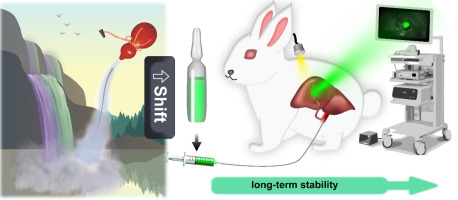
Accurate identification of surgical margins for malignancy remains a challenge in the surgical therapy of cancer, and this encountered interoperative difficulties which directly contribute to the prognosis of patients. In recent years, indocyanine green (ICG) has been approved and applied in clinical settings for lesions detection, especially for the precise surgical resection. However, rapid clearance and poor stability greatly limit its clinical practicality. Herein, a super-stable homogeneous iodinated formulation technology (SHIFT) is designed to realize sufficient dispersion of ICG into lipiodol (SHIFTs) for transcatheter embolization (TAE) synergistic fluorescence-guided resection. Particularly, SHIFTs is prepared in a green physical mixture via a carrier-free manner, which possesses controlled morphology, long-term stability, and improved optical characteristics of ICG (fluorescence/photoacoustic/photothermal activities). Furthermore, the viscosity of the synthetic solvent is comparable to lipiodol, and further assessment demonstrated the same efficacy in computed tomography. The performance of SHIFTs in the fluorescence navigation was further evaluated in vivo by TAE therapy to the rabbit VX2 tumor model for a two-week monitor. The integration of near-infrared fluorescence surgery navigation and TAE could effectively guarantee the precise resection for hepatocellular carcinoma. This SHIFT system provides good potentials for ameliorating the dilemma of precise fluorescent navigation for surgical resection after arterial embolization in clinical practice.
文章链接:https://doi.org/10.1016/j.jconrel.2020.04.021
文章导读:https://doi.org/10.1360/TB-2020-0719